CASE STUDY | MEDICAL COLLEGE OF WISCONSIN
Real-time Motion Management for a Small Target in the Right Lower Lobe With Large Tumor Motion Using Radixact® Synchrony®: A Case Report
Authors:
Challenge:
Solution:
Case Information:
| Patient | 73-year-old woman with a history of metastatic rectal cancer with oligoprogressive disease to the liver and lung. |
| History | Received previous SBRT treatment to a right lung lesion 1.5 years earlier. |
| Current Presentation | New lesion in the right lower lobe (Figure 1). |

Treatment:
| Margins | PTV was a 5 mm expansion of GTV. |
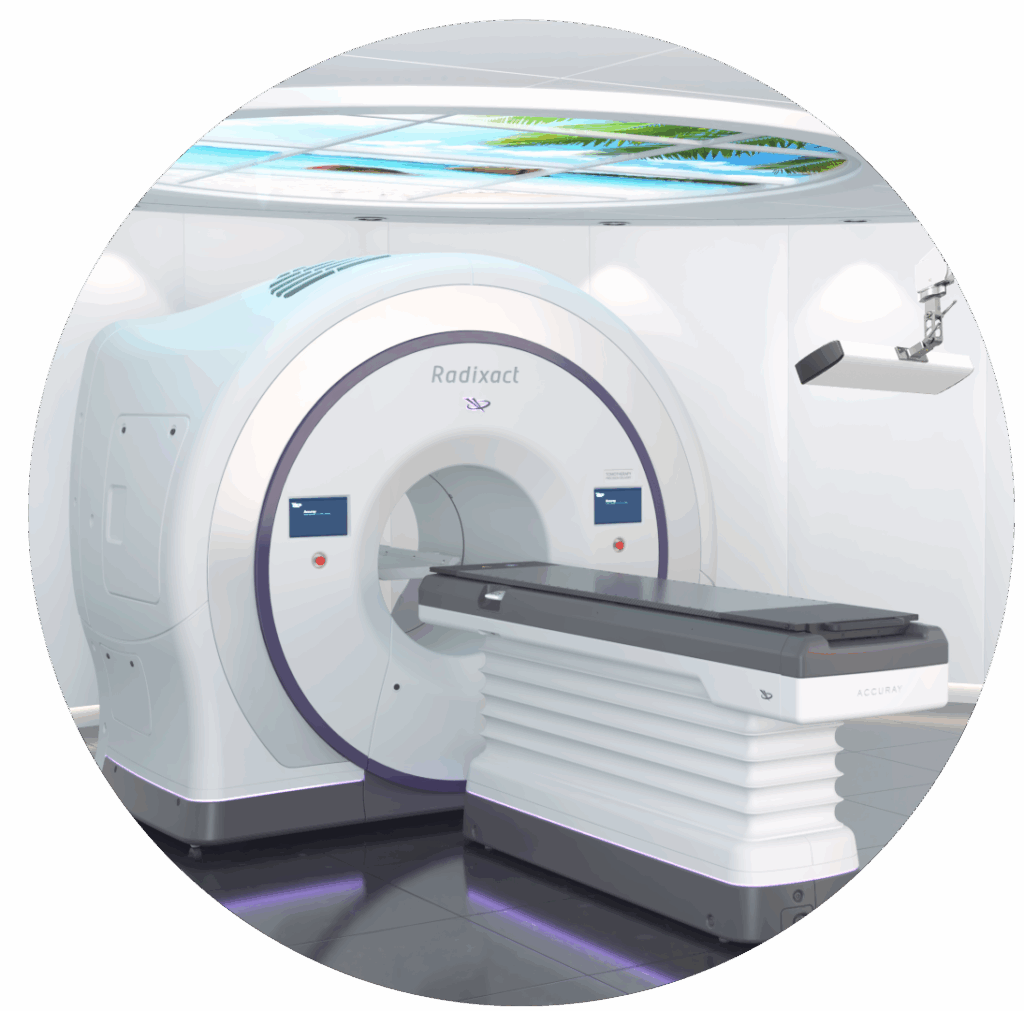
| Tracking Technique | Synchrony® fiducial-free tracking with 4 radiographic image angles per rotation was used. A simulation session confirmed the feasibility of accurate tracking using external LED markers and radiographic imaging. |
| Dose | 54 Gy in 3 fractions. |
| Planning Constraints | All organ at risk constraints of the RTOG 0234 protocol were met. |
| Beam-on-time | 10.41 minutes. |
Outcomes:
Key advantages of Synchrony on the Radixact® System :
- Continuous real-time motion tracking without fiducials
- High tracking accuracy despite large motion amplitude
- Minimized treatment margins, reducing normal lung exposure
- Efficient dose delivery with no significant increase in treatment time
Conclusion:
“Small lung lesions with large motion are more prone to being missed during treatment, and treatment with a large margin increases radiation exposure to healthy tissue. This case study demonstrates the clinical feasibility and effectiveness of Radixact® Synchrony in managing significant respiratory-induced tumor motion for a small lesion in the lung. Future studies should explore long-term outcomes and dosimetric refinements for further optimization”
Chen G, Tai A, Puckett L, et al. (June 01, 2025) Real-Time Motion Management for a Small Target in the Right Lower Lobe With Large Tumor Motion Using Radixact Synchrony: A Case Report. Cureus 17(6): e85195. doi:10.7759/cureus.8519
Synchrony® is available in the US and EU markets. This feature may not be commercially available in all markets and is subject to regulatory clearance or approval. Kindly contact your regional Accuray representative or distributor to confirm the regulatory status.
Important Safety Information:
Most side effects of radiotherapy, including radiotherapy delivered with Accuray systems, are mild and temporary, often involving fatigue, nausea, and skin irritation. Side effects can be severe, however, leading to pain, alterations in normal body functions (for example, urinary or salivary function), deterioration of quality of life, permanent injury, and even death. Side effects can occur during or shortly after radiation treatment or in the months and years following radiation. The nature and severity of side effects depend on many factors, including the size and location of the treated tumor, the treatment technique (for example, the radiation dose), and the patient’s general medical condition, to name a few. For more details about the side effects of your radiation therapy, and to see if treatment with an Accuray product is right for you, ask your doctor. Accuray Incorporated as a medical device manufacturer cannot and does not recommend specific treatment approaches. Individual results may vary.
© 2025 Accuray Incorporated. All Rights Reserved. Accuray, the Accuray logo, and other trademarks are trademarks or registered trademarks of Accuray Incorporated and may not be used without permission. For more information on Accuray and its trademarks, please visit www.accuray.com/trademarks. MKTRXCSCC17092025#5