CASE STUDY | SAHYADRI SUPER SPECIALITY HOSPITAL
Prostate Stereotactic Body Radiotherapy With Synchrony®-based Fiducial Tracking On the Radixact® Treatment Delivery System
Authors:
Purpose:
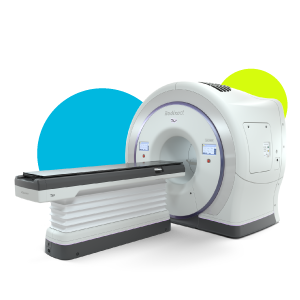
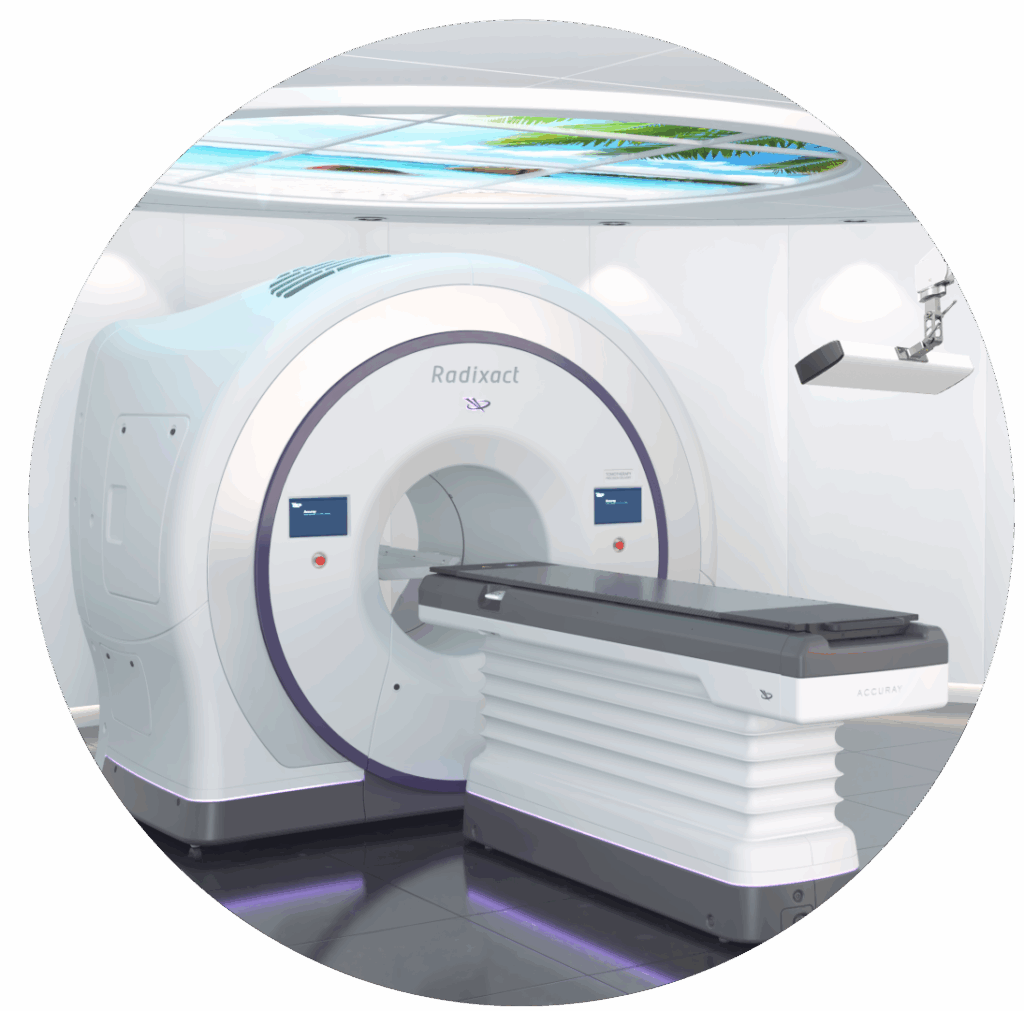
This case series reports the clinical experience of delivering stereotactic body radiation therapy (SBRT) for localized prostate cancer using the Radixact® X9 System with Synchrony® fiducial-based real-time motion tracking.
Methods:
| Design | Retrospective study of 7 men with organ-confined prostate cancer |
| Risk Groups | 29% favourable intermediate risk, 57% unfavourable intermediate risk, 14% high risk |
| Motion Management | Synchrony® for intrafraction motion management using 3 gold fiducials, placed under ultrasound guidance — 2 weeks prior to simulation |
| Planning | Accuray Precision® Treatment Planning System with VOLOTM Ultra optimizer, using TomoHelicalTM technique with 2.5 cm dynamic jaw. The CTV included the proximal 1 cm of seminal vesicles. An isotropic margin of 3 mm was used to form the PTV. Dose constraints followed NRG-GU005 protocol with minor modifications |
| Treatment | Radixact SBRT, 36.25 Gy in five consecutive fractions. Daily ClearRT® kVCT imaging for patient alignment (see Figure 1) |
| Follow-up | Minimum of 5-6 months |

Results:
| Average Beam on Time | 8 minutes |
| Toxicity | All patients experienced ≤Grade 2 genitourinary toxicity, which was slightly higher in patients with prior urological procedures. No ≥Grade 3 toxicities. All patients tolerated treatment well and all acute toxicities subsided during the 5-6 month follow-up period. |
| Clinical Outcomes | PSA levels declined post-treatment to <0.3 ng/mL |
Conclusion:
Limitations include small patient cohort and limited follow-up duration
Acharya A, Hunugundmath S, Deputy M, et al. (May 08, 2025) Prostate Stereotactic Body Radiotherapy With Synchrony®-Based Fiducial Tracking on Radixact® X9. Cureus 17(5): e83742. doi:10.7759/cureus.837
Important Safety Information:
Most side effects of radiotherapy, including radiotherapy delivered with Accuray systems, are mild and temporary, often involving fatigue, nausea, and skin irritation. Side effects can be severe, however, leading to pain, alterations in normal body functions (for example, urinary or salivary function), deterioration of quality of life, permanent injury, and even death. Side effects can occur during or shortly after radiation treatment or in the months and years following radiation. The nature and severity of side effects depend on many factors, including the size and location of the treated tumor, the treatment technique (for example, the radiation dose), and the patient’s general medical condition, to name a few. For more details about the side effects of your radiation therapy, and to see if treatment with an Accuray product is right for you, ask your doctor. Accuray Incorporated as a medical device manufacturer cannot and does not recommend specific treatment approaches. Individual results may vary
© 2025 Accuray Incorporated. All Rights Reserved. Accuray, the Accuray logo, and other trademarks are trademarks or registered trademarks of Accuray Incorporated and may not be used without permission. For more information on Accuray and its trademarks, please visit www.accuray.com/trademarks. MKTRXCSCC160925#3